Abstract
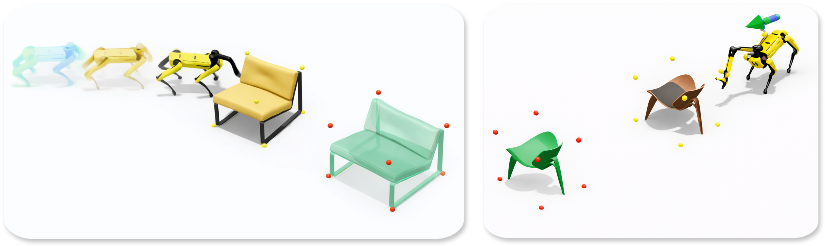
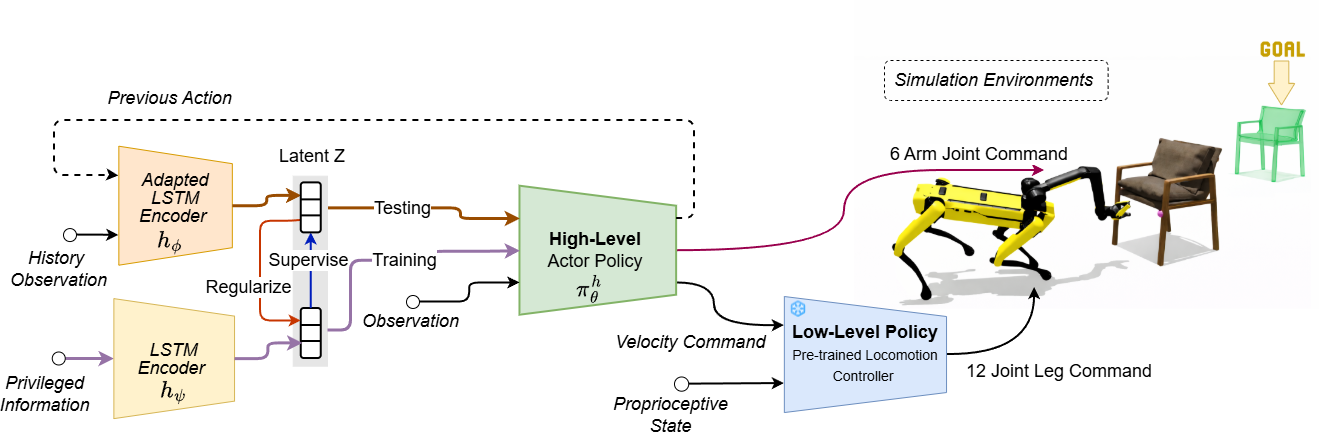
Non-prehensile manipulation enables robots to reposition objects through contact across diverse geometries and physical properties without relying on grasping. We study goal-directed arm-mediated object pushing with a quadrupedal mobile manipulator and propose a hierarchical reinforcement learning framework that decouples task-level decision making from low-level dynamic stabilization. The high-level policy outputs target base velocities and arm-joint targets. A pretrained low-level locomotion policy tracks the base command to produce dynamically stable locomotion, while a separate arm controller tracks the commanded joint targets. To guide exploration toward feasible robot-object interactions, we introduce geometry-guided contact sampling from the object point cloud and use the sampled target to shape end-effector reaching before shifting emphasis toward the object-pose objective. We evaluate performance and robustness across object families and distribution shifts. The learned policy remains effective under geometry and physics variation and generalizes to unseen everyday-object geometries. Ablations further show that contact guidance, the staged reward curriculum, and online adaptation are important for learning and transfer.
System Diagram
Method
The policy stack has two levels: a high-level goal-conditioned actor for task strategy and a frozen low-level locomotion prior for dynamic stability. The actor outputs base velocities together with arm-joint targets for arm-mediated pushing.
- Geometry-aware contact intent sampled from object point clouds
- Adaptive reach-reward curriculum for stable contact acquisition
- Evaluation across randomized objects, distribution shifts, and unseen geometries
Key Quantitative Results
| Suite | Cuboid C1 (%) | Cuboid C2 (%) | Cylinder C1 (%) | Cylinder C2 (%) |
|---|---|---|---|---|
| ID | 91.88 | 85.63 | 92.46 | 86.35 |
| OOD Geometry | 76.24 | 61.80 | 74.37 | 65.00 |
| OOD Physics | 66.87 | 51.88 | 70.00 | 66.87 |
Criterion 1 (C1) uses translation and yaw tolerances of 15 cm and 15°, respectively. Criterion 2 (C2) uses stricter tolerances of 10 cm and 10°.